Explainer · June 11, 2026 · 5 min · By Caleb Trevino
Collagen Banking in Beverly Hills: What Poly-L-Lactic Acid and Calcium Hydroxylapatite Actually Do
Biostimulatory injectables are marketed as a way to build your own collagen instead of filling space. Here is how the two main materials work, how they differ, and where the marketing outruns the biology.
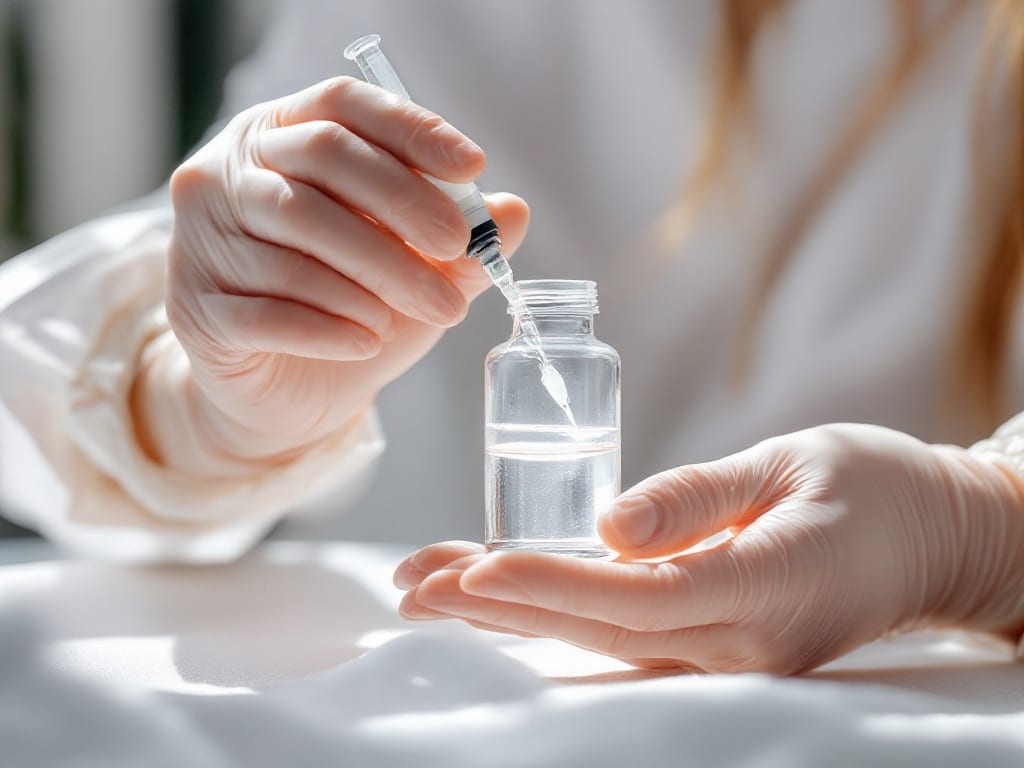
Walk through the consultation rooms of Beverly Hills and you will hear the phrase collagen banking more often than the word filler. The pitch is appealing: rather than injecting a gel that occupies volume, inject a material that prompts your skin to manufacture its own structural protein. Two products dominate this category, poly-L-lactic acid, often abbreviated PLLA, and calcium hydroxylapatite, abbreviated CaHA. Both are FDA cleared, both have decades of safety data, and both are routinely oversold. Understanding the mechanism helps you ask better questions.
How biostimulation actually works. Neither material adds meaningful volume on its own after the first few weeks. PLLA is supplied as a powder of microparticles suspended in sterile water before injection. Once placed in the deep dermis or subcutaneous plane, the particles trigger a controlled foreign body response. Macrophages surround the particles, fibroblasts are recruited, and over roughly 8 to 12 weeks those fibroblasts deposit new type I collagen around the degrading particles. The particles themselves hydrolyze into lactic acid and are metabolized. What remains is your own collagen scaffold. CaHA works on a similar principle but with a different timeline. Its microspheres sit in a carboxymethylcellulose gel that provides immediate lift. The gel absorbs over several months while the calcium-based spheres stimulate fibroblast activity, then gradually break down into calcium and phosphate ions the body already handles.
The practical differences. CaHA gives you something to see on day one because of its carrier gel, which makes it easier to assess placement and symmetry at the time of treatment. PLLA gives you almost nothing visible at first. The water carrier absorbs within days, the face returns to baseline, and results emerge slowly over two to three months. This delayed onset is a feature, not a flaw, because gradual change reads as natural, but it requires patience and usually a series of two to four sessions spaced about a month apart. CaHA is often used for defined structural areas such as the jawline, chin, and the backs of the hands. PLLA is favored for diffuse volume loss across the temples, midface, and lateral cheeks, and in diluted form for skin quality on the neck, chest, and body.
Duration claims, checked. Marketing commonly states that PLLA lasts two years or more and CaHA 12 to 18 months. The honest version: the injected material is gone well before then. What persists is the collagen your fibroblasts built, and that collagen ages the way the rest of your collagen does, degrading slowly under the influence of UV exposure, glycation, and time. Studies do support visible improvement at the two year mark for PLLA in many patients, but the result is not a fixed deposit. It is biological tissue subject to ordinary turnover.
The myths worth flagging. First, biostimulators are not reversible. Hyaluronic acid fillers can be dissolved with hyaluronidase within hours if a problem arises. There is no enzyme that erases PLLA or CaHA. If nodules form, management involves massage, dilute steroid or saline injections, and time, sometimes many months of it. Second, the claim that these products are safer because they are natural does not hold up. PLLA is a synthetic polymer, the same family of material used in dissolvable sutures. CaHA is a mineral compound. Both are biocompatible, but biocompatible is not the same as risk free. Vascular occlusion remains possible with any injectable, and because these products cannot be dissolved, injector technique and anatomical knowledge matter even more than with hyaluronic acid. Third, more sessions do not bank unlimited collagen. Fibroblast response plateaus, and overcorrection in areas like the temples or under the eyes can look puffy and is difficult to undo.
Who is a reasonable candidate. Biostimulators tend to suit patients in their late thirties to sixties with generalized volume loss and thinning skin who want gradual improvement and accept a multi-visit timeline. They are a poor fit for anyone wanting an immediate event-ready change, anyone with active autoimmune inflammatory conditions where granuloma risk is debated, and the tear trough, where both materials carry elevated nodule risk and most careful injectors avoid them entirely.
Questions to bring to a consultation. Ask how the PLLA will be diluted and how long it will hydrate before injection, since higher dilution and longer reconstitution times are associated with lower nodule rates. Ask how many vials or syringes the plan involves across how many sessions, and what the total cost will be, because per-session pricing obscures the real number. Ask what the plan is if a nodule appears at month four. A clinician who answers these without flinching understands the material. One who promises permanent results from a single session does not, because the biology says otherwise.
Related reading: The Beverly Hills look, 2026.