Explainer · June 12, 2026 · 5 min · By Ingrid Pavlenko
Hyaluronic Acid Fillers vs. Biostimulators: What Beverly Hills Injectors Are Actually Choosing, and Why
Two categories of injectables dominate consultation rooms along the Wilshire corridor. They look similar in the syringe but work through completely different biology. Here is the mechanism-level breakdown patients rarely get.
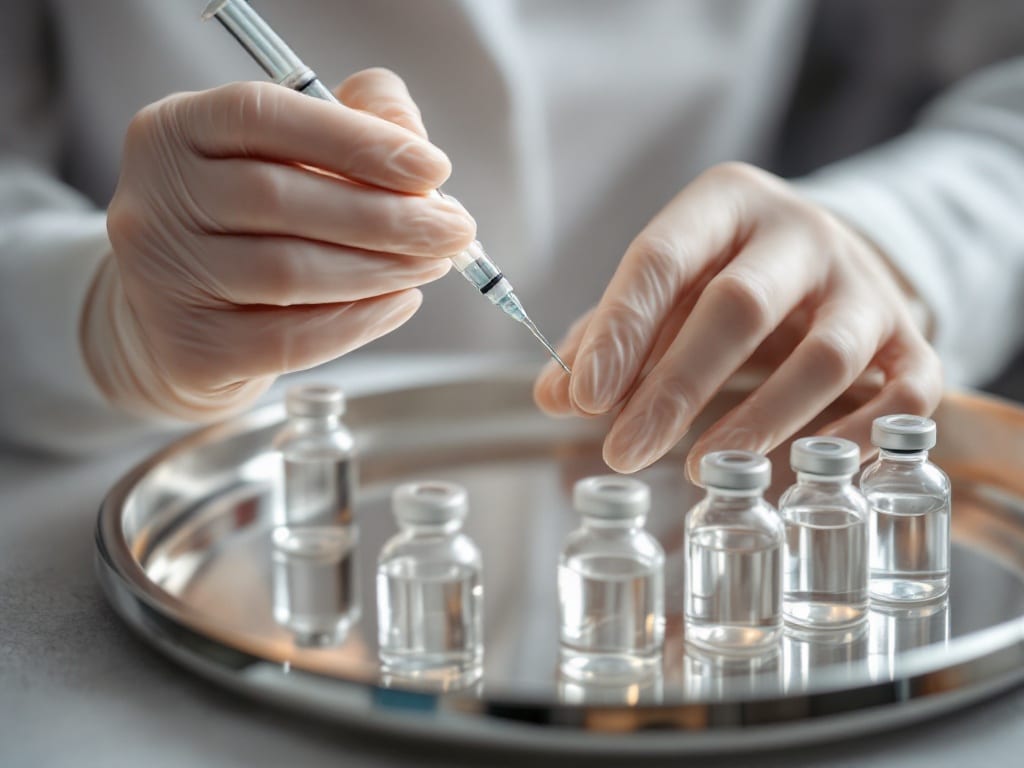
Walk into almost any dermatology practice in Beverly Hills and the injectable conversation now splits into two distinct tracks. The first is the familiar one: hyaluronic acid fillers, the gels that add immediate volume. The second is newer in popularity, if not in age: biostimulatory injectables such as poly-L-lactic acid and calcium hydroxylapatite, which do not fill so much as provoke. Understanding the difference matters, because the two categories carry different timelines, different reversibility profiles, and different failure modes.
How hyaluronic acid fillers work. Hyaluronic acid is a sugar molecule, a glycosaminoglycan, that occurs naturally in skin and binds large amounts of water. Injectable versions are cross-linked so the gel holds its shape rather than dissolving within days. The mechanism is mostly physical: the gel occupies space, draws in water, and lifts or smooths the overlying tissue. Results are visible immediately, which is a large part of the category's appeal. Different products vary in cross-linking density and particle size, which changes how firm or spreadable the gel is. A stiffer gel resists deformation and suits deep structural placement along bone. A softer gel integrates into mobile tissue like lips. Duration typically runs six to eighteen months depending on product and location, though MRI studies have shown filler persisting far longer than labels suggest, sometimes years, particularly under the eyes.
The key advantage: reversibility. Hyaluronic acid can be dissolved with hyaluronidase, an enzyme that breaks the gel apart within hours to days. This is not a minor footnote. It is the safety net that makes the entire category manageable. If a result looks wrong, or in the rare emergency of a vascular occlusion where filler blocks a blood vessel, the enzyme provides an exit. No biostimulator offers an equivalent.
How biostimulators work. Poly-L-lactic acid, the molecule behind the best-known biostimulator, is a biodegradable polymer long used in dissolvable sutures. Injected as a suspension of microparticles, it does almost nothing on day one. Over weeks, the particles trigger a controlled, subclinical inflammatory response. Macrophages arrive, fibroblasts activate, and those fibroblasts begin laying down new collagen, predominantly type I, around the particles. The particles themselves degrade over months into lactic acid and are metabolized. What remains is the patient's own collagen scaffold. Calcium hydroxylapatite works on a related principle: the microspheres provide some immediate lift from the carrier gel, then stimulate collagen as the gel absorbs.
The practical consequences of that mechanism. Biostimulator results build slowly, usually over two to three sessions spaced four to six weeks apart, with full effect at three to six months. The trade is patience for longevity and texture: because the result is native collagen rather than implanted gel, many clinicians describe it as firmer and more diffuse, better suited to broad areas like the temples, cheeks, and jawline than to precise sculpting. Duration commonly reaches two years or more. The downside is the same as the upside. You cannot dissolve your own collagen with an enzyme. Overcorrection, asymmetry, or nodules must be managed with time, massage, dilute steroid injection, or in stubborn cases other interventions, not a quick reversal.
The nodule question, honestly answered. Early formulations of poly-L-lactic acid earned a reputation for palpable papules, largely because reconstitution volumes were too low and injection was too superficial. Current protocols use higher dilution, longer hydration times, deeper placement, and vigorous post-treatment massage, and nodule rates have fallen substantially. They have not fallen to zero. Any patient considering the category should hear that plainly.
So which is appropriate when? A reasonable clinical framework looks like this. Discrete, well-defined volume loss with a desire for immediate, adjustable, reversible results favors hyaluronic acid: lips, nasolabial folds, chin projection, under-eye hollows in carefully selected patients. Diffuse volume loss across larger surfaces, skin laxity with thinning dermis, and patients in their forties onward who want gradual, natural-reading change favor biostimulators. Many practices now combine them, using hyaluronic acid for structure in one visit and a biostimulator series for global collagen support over the following months.
What to ask at a consultation. Ask which product is proposed and why that mechanism fits your anatomy, not just your goal. Ask how the injector manages complications specific to that product, including whether hyaluronidase is stocked on site. Ask about total cost across the full series, since biostimulators are usually priced per vial across multiple sessions and the sticker comparison with a single filler syringe is misleading in both directions.
Neither category is the upgrade of the other. They are different tools acting on different biology, and the best outcomes in this city tend to come from injectors who can explain, in plain terms, exactly which mechanism they are recruiting and why.
Related reading: Biostimulators vs. Hyaluronic Acid Fillers: What 'Collagen Stimulation' Actually Means.