
Explainer · July 26, 2026 · 5 min · By Noor El-Amin
Ablative vs. Non-Ablative Fractional Lasers: What the Beam Actually Does to Your Skin
Beverly Hills patients hear both terms in nearly every resurfacing consult. Here is the mechanism-level difference, who each approach actually suits, and why downtime is not the only variable that matters.
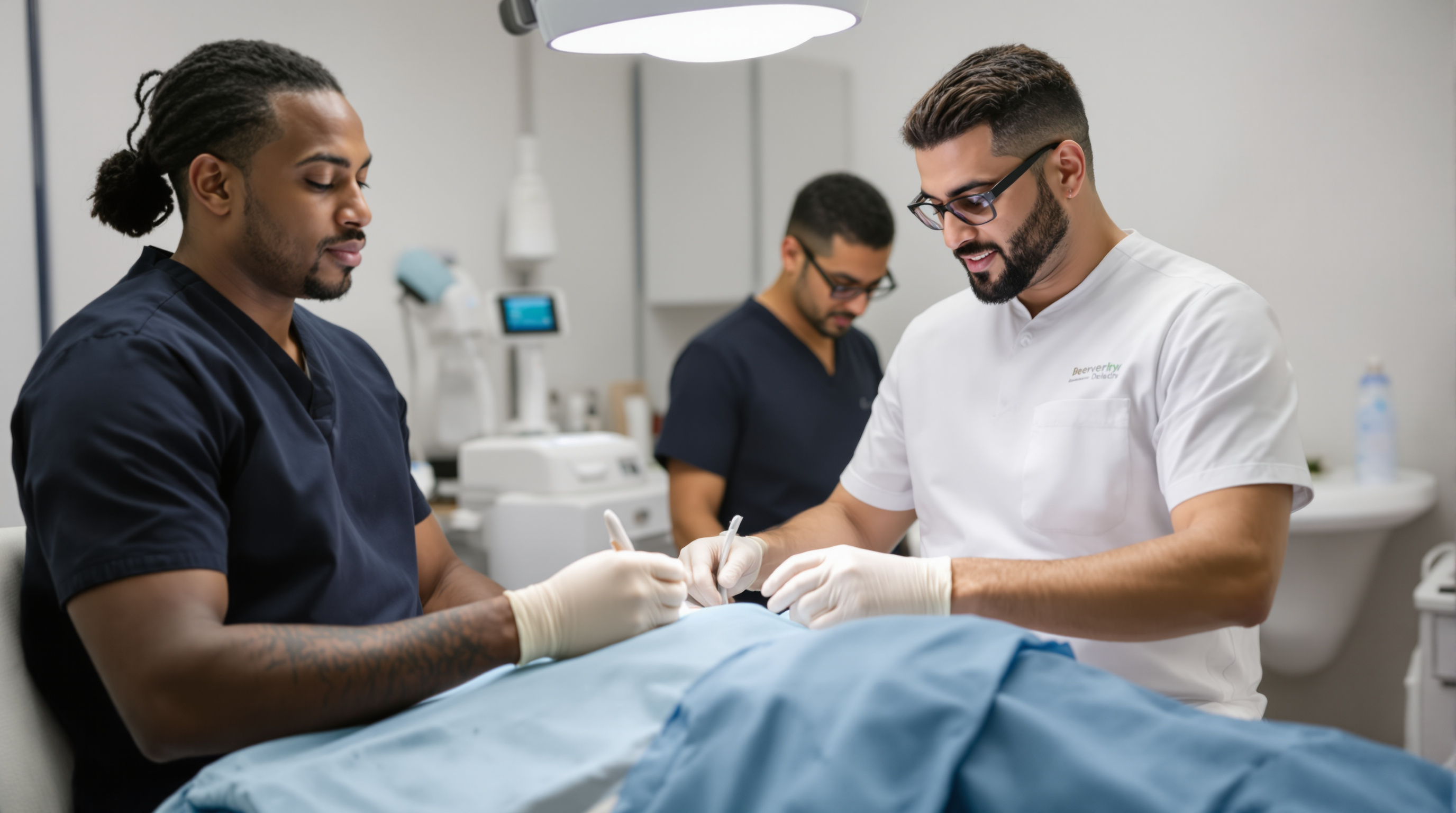
Walk into almost any consultation for texture, acne scarring, or photoaging in Beverly Hills and you will hear the same fork in the road: ablative or non-ablative fractional resurfacing. Both are legitimate tools. Both have decades of peer-reviewed literature behind them. But they work through genuinely different mechanisms, and choosing between them based on marketing language rather than tissue biology is how patients end up disappointed, or worse, hyperpigmented.
Start with the physics. All resurfacing lasers work by targeting water in the skin. When the laser wavelength is absorbed by water molecules, the energy converts to heat. What separates the two categories is how much heat, and whether tissue is actually removed. Ablative lasers, typically carbon dioxide at 10,600 nanometers or erbium:YAG at 2,940 nanometers, deliver enough energy to vaporize columns of skin outright. Non-ablative lasers, commonly in the 1,440 to 1,927 nanometer range, heat columns of tissue to the point of coagulation without vaporizing them. The epidermis stays intact. In plain terms: ablative removes and rebuilds, non-ablative injures and remodels.
The word fractional matters just as much. Older fully ablative resurfacing treated the entire surface at once, which produced dramatic results and equally dramatic recovery, sometimes weeks of open wound care. Fractional delivery, introduced in the mid-2000s, splits the beam into thousands of microscopic treatment zones surrounded by untouched skin. Those intact bridges of tissue act as reservoirs of keratinocytes and stem cells that migrate into the injured columns and accelerate healing. This is why a fractional ablative treatment that would have been a two-week ordeal in fully ablative form now typically involves five to seven days of visible recovery.
What each one is actually good at. Ablative fractional resurfacing produces more collagen remodeling per session because the injury is deeper and the wound-healing cascade is more robust. For rolling and boxcar acne scars, etched-in perioral lines, and significant photodamage, one to two ablative sessions often outperform four to six non-ablative sessions. Non-ablative fractional treatment shines where the goal is refinement rather than reconstruction: early sun damage, mild texture, enlarged-appearing pores, and maintenance in patients who cannot schedule real downtime. The 1,927 nanometer thulium wavelength in particular targets superficial pigment and dyschromia effectively because its water absorption keeps energy concentrated in the upper layers where sun spots live.
Downtime is the visible tradeoff, but not the only one. Ablative recovery involves oozing, crusting, and obligate wound care with occlusive ointments for several days, followed by weeks of pinkness. Non-ablative recovery usually looks like a sunburn with fine sandpaper texture for three to five days, with makeup permitted quickly. But the less discussed variable is cumulative cost and time. A non-ablative series requires multiple visits spaced roughly a month apart, and total spending can approach or exceed a single ablative treatment. Patients comparing sticker prices per session are often comparing the wrong numbers.
Skin tone changes the calculus significantly. The dominant risk with any thermal resurfacing in Fitzpatrick types IV to VI is post-inflammatory hyperpigmentation, driven by melanocytes responding to heat and inflammation. Ablative treatments carry higher risk here because the thermal injury is greater. Experienced clinicians manage this with conservative density settings, pre-treatment and post-treatment topical regimens such as hydroquinone or other tyrosinase inhibitors, and strict photoprotection, but many will steer deeper skin tones toward non-ablative devices or lower-density ablative protocols. Anyone with medium to deep skin who is quoted aggressive ablative settings without a pigment management plan should ask more questions.
Common myths worth retiring. First, non-ablative does not mean risk-free. Bulk heating at high densities can still cause blistering and pigment change. Second, ablative results are not permanent. The laser resets accumulated damage; it does not stop aging or future ultraviolet exposure. Third, more passes and higher energy do not linearly equal better outcomes. Beyond a point, excess thermal injury increases scarring risk without improving collagen yield.
Questions to bring to a consult. Ask which wavelength and device the practice uses and why it fits your specific indication. Ask how many sessions the treatment plan assumes and the total cost across the series. Ask specifically how your skin type affects settings and pre-treatment. And ask who fires the laser: in California, laser treatments must be performed by, or under appropriate physician supervision of, licensed medical professionals, and the operator's experience with your skin type matters as much as the device on the wall.
Neither category wins outright. Ablative fractional resurfacing is the heavier tool for deeper structural problems in patients who can absorb real recovery. Non-ablative is the incremental tool for surface refinement and busy schedules. The right answer comes from matching the depth of the problem to the depth of the injury, not from whichever device a practice happens to have purchased.
Related reading: Mohs Surgery, Explained: Why the Gold Standard for Skin Cancer Removal Takes All Day.
More in Explainer
View all →- RF Microneedling vs. Traditional Microneedling: What the Energy Actually Adds
- Why Melasma Often Gets Worse After Laser, and What Actually Works
- Ultrasound Before the Syringe: Why Beverly Hills Injectors Are Mapping Faces First
- Fillers That Fill vs. Fillers That Build: How Biostimulatory Injectables Actually Work