
Explainer · July 29, 2026 · 5 min · By Noor El-Amin
Sculptra, Radiesse, and the Rise of the Biostimulator: What Collagen Injectables Actually Do
Beverly Hills injectors increasingly pitch biostimulatory fillers as a natural alternative to hyaluronic acid. Here is how the science holds up, where the results come from, and what patients should ask before committing to a multi-session protocol.
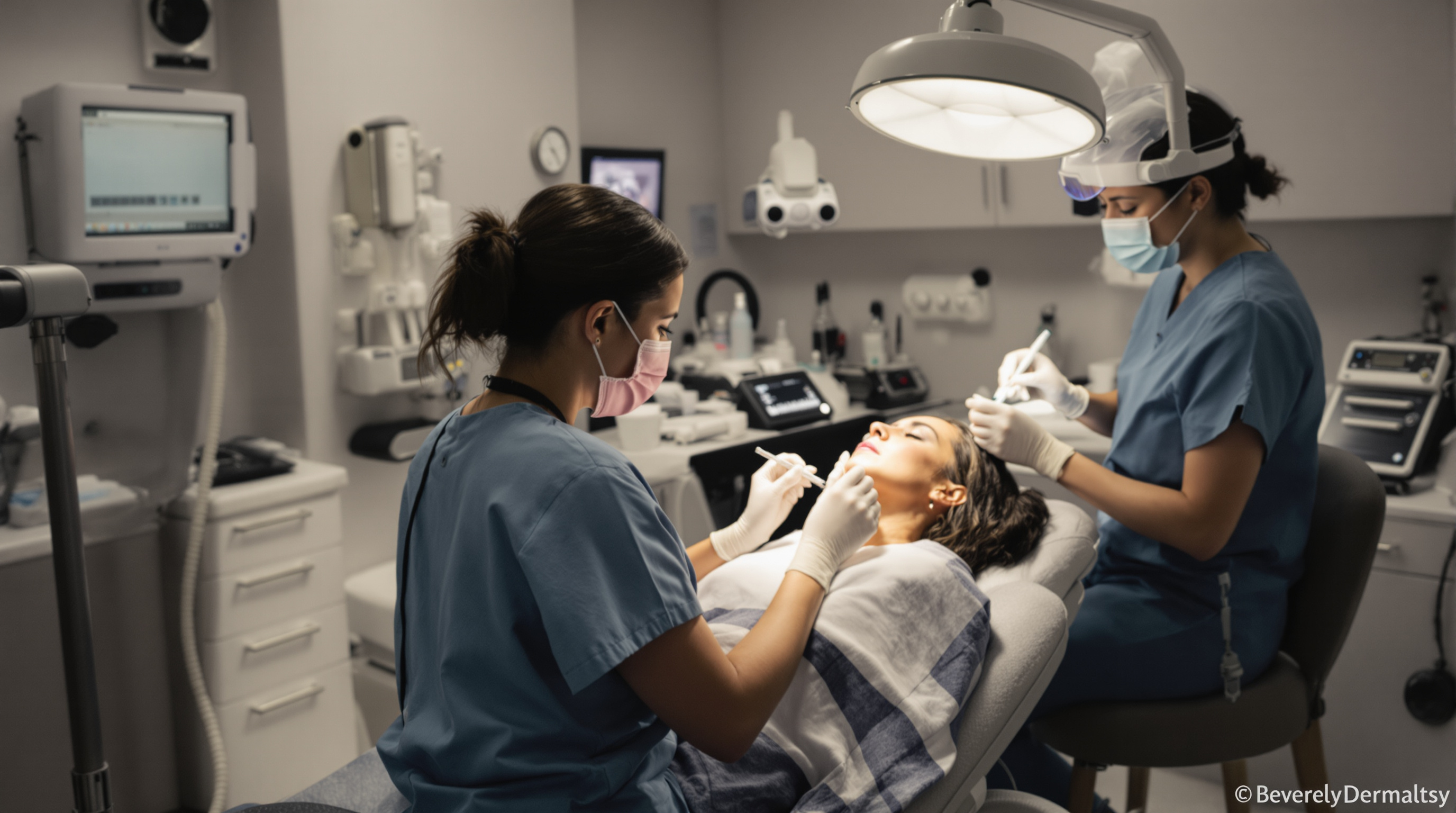
Walk into almost any cosmetic dermatology practice in Beverly Hills right now and you will hear the word biostimulator. The pitch is appealing: instead of filling a wrinkle with gel, these injectables prompt your own skin to build new collagen. The two most established products in this category are poly-L-lactic acid, sold under the brand name Sculptra, and calcium hydroxylapatite, sold as Radiesse. Both are FDA approved, both have decades of clinical use, and both are frequently misunderstood by the people receiving them.
The mechanism, in plain terms. Hyaluronic acid fillers work by volume. The gel occupies space, binds water, and lifts tissue immediately. Biostimulators work differently. Poly-L-lactic acid consists of microscopic particles of a biodegradable polymer, the same family of material used in dissolvable sutures. When injected into the deep dermis or subcutaneous plane, the particles trigger a controlled foreign body response. Fibroblasts, the cells responsible for producing collagen, migrate to the area, encapsulate the particles, and lay down new type I collagen over weeks to months. Calcium hydroxylapatite works on a similar principle but with a different material: microspheres of a mineral compound chemically similar to bone, suspended in a gel carrier. The carrier gives some immediate lift, then dissipates while the microspheres stimulate fibroblast activity.
Why the timeline matters. This mechanism explains the single most common source of patient disappointment. Poly-L-lactic acid produces almost no lasting result at the first appointment. The water used to reconstitute the product creates a temporary fullness that resolves within days, and patients sometimes interpret that as the product failing. The actual collagen response builds gradually, typically requiring two to three sessions spaced four to six weeks apart, with full results visible around three to six months after the final treatment. Histology studies have documented measurable increases in dermal collagen at those intervals. Calcium hydroxylapatite splits the difference: patients see immediate correction from the carrier gel plus a slower biostimulatory contribution over subsequent months.
Longevity claims, checked. Marketing materials often state that results last two years or more. The published data are more nuanced. Pivotal trials for poly-L-lactic acid in facial lipoatrophy showed durable improvement at 24 months in a majority of subjects, but individual response varies with age, baseline skin quality, and metabolic factors. The collagen produced is your own, and it ages like the rest of you. A realistic framing is that biostimulators shift the baseline rather than freezing it: skin thickness and firmness improve, then continue to decline along the normal aging curve from that higher starting point.
Where these products fit, and where they do not. Biostimulators excel at diffuse volume loss and skin quality problems: hollowing of the temples and cheeks, crepey texture over the lower face, thinning skin on the neck, chest, arms, and buttocks when used off label in diluted form. They are poorly suited to precise shaping. Lips are contraindicated for both products because of nodule risk in highly mobile tissue, and the tear trough is widely avoided by experienced injectors for the same reason. A hyaluronic acid filler remains the better tool when a patient wants a defined change in a specific contour, partly because it is reversible with hyaluronidase. Biostimulators are not reversible. Once the collagen response is underway, there is no dissolving enzyme, which raises the stakes on injector technique and product dilution.
The nodule question. Early formulations of poly-L-lactic acid earned a reputation for palpable papules and nodules. Modern protocols have reduced that risk substantially through higher dilution volumes, longer reconstitution times, deeper injection planes, and strict post-treatment massage instructions, often summarized as five minutes, five times a day, for five days. Nodule rates in contemporary studies run in the low single digits, but they are not zero, and delayed nodules can appear months after treatment. Patients with a history of granulomatous or autoimmune conditions should discuss this explicitly during consultation.
Questions worth asking before you book. How many vials does the injector anticipate over the full protocol, and what is the total cost, since biostimulators are priced per vial or syringe and typically require multiples. What dilution and injection plane will be used. What is the plan if a nodule forms. And is a biostimulator actually the right tool for your concern, or is it being offered because it generates a multi-visit treatment plan.
The honest summary: biostimulatory fillers are real, mechanistically sound, and well supported for gradual, natural-looking improvement in volume and skin quality. They reward patience and punish imprecision. In a market as saturated as Beverly Hills, the technology is rarely the variable that determines the outcome. The hands holding the needle usually are.
Related reading: Sculptra vs. Radiesse: What Collagen Biostimulators Actually Do Under the Skin.
More in Explainer
View all →- RF Microneedling vs. Traditional Microneedling: What the Energy Actually Adds
- Why Melasma Often Gets Worse After Laser, and What Actually Works
- Ultrasound Before the Syringe: Why Beverly Hills Injectors Are Mapping Faces First
- Fillers That Fill vs. Fillers That Build: How Biostimulatory Injectables Actually Work